
[Tobisho] SR-2 Pruning Shears 185mm (7.3") [TBS010102]

⚠️ Important Notice for 🇺🇸 US, 🇪🇺 EU, and 🇬🇧 UK Customers (View details)
Related Items
-

[Tobisho] Legacy Spring (Pre-Integration) for Older 180mm/185mm Pruners [TBS019901]
220JPY (not include VAT & TAX)
Not available
The Size This Line Has Since Replaced About Legacy Spring (Pre-Integration) for Older 180mm/185mm…
-
[NANIWA] Gouken Curved Water whetStone (#1000) [NNW010102]



1,650JPY (not include VAT & TAX)
Stock:94
Fine Whetstone (artificial, #1000), for pruning secateurs and all of curved edges. #1000 is medium f…
Item Description
Feels more compact. Performs large. — Premium Japanese Hand-Forged Pruning Shears
About the Tobisho SR Series
The SR was developed by the late master Yasuhito Tobitsuka, Tobisho's third-generation master, as a synthesis of everything that came before it. His brief to himself: take the strengths of the A-type and the B-type, and build something better than both.
The name carries a declaration. SR stands for Secateurs Revolution, first reported by Hiroshi Urata, founder of EDGEs and owner of Tetsufuku, who heard it directly from Tobisho.
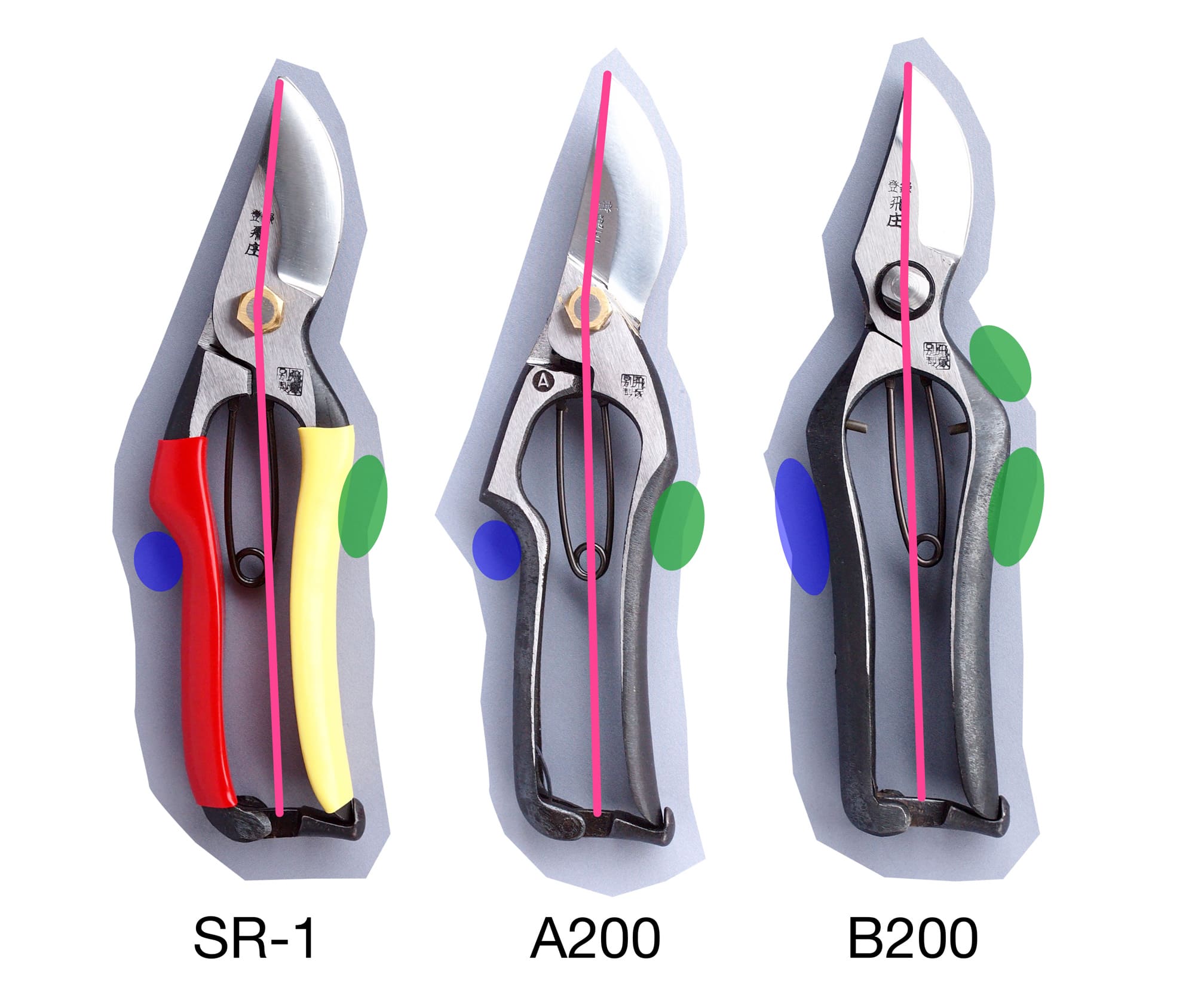
Tobisho's A-type has a bold, shoulder-forward silhouette. It cuts with decisive force: batsun. The B-type is nearly symmetrical, slender. It cuts cleanly and lightly: sakutto. The SR lands between them. Pakon. Lighter than the A, more deliberate than the B. The SR doesn't snap or glide, it cuts.
Pick it up and it feels compact, more settled in the hand than the specs suggest. The balance comes from the inside: the handle is formed by bending flat-forged steel around a die, where to curve, where to leave mass, all precisely controlled. That geometry is Yasuhito's work. So is the blade geometry, the handle shape, the overall dynamics. The SR carries his accumulated experience in every dimension.
The result is what Tobisho calls their signature model. When television crews visit the forge, the SR is what they film. When magazines run features on Tobisho, the SR is what they photograph. It is the shear Tobisho shows the world.
About Tobisho SR-2 Pruning Shears 185mm (7.3")
The SR-2 is the compact model in the SR series: 185mm, approximately 220g, right-handed. It shares the same steel, the same construction, and the same standards as the SR-1, 15mm shorter.
That 15mm changes how the shear sits in the hand. The SR-2 pulls the pivot closer to the palm, tightening the arc of each cut. Gardeners who work with a gripped, precise motion, trimming close, working into density, making many small cuts in succession, often find this geometry more natural than a longer shear allows.
Among professional gardeners in Japan, compact shears have a quiet following. Not among small-handed people, but among those who have decided that anything thicker than a finger goes to the saw. That decision changes everything: once you stop asking the shear to do what a saw should do, a smaller shear stops feeling like a compromise and starts feeling like a tool that fits the work.
The SR-2 brings that logic to the SR series. The performance is the same. The reach is shorter. What you gain is precision and a shear that disappears into the hand.
Steel: YCS-3 (Yasuki Steel), full-body forged. The inner face of each blade is ground to a three-dimensional curve (a traditional Japanese hollow-ground geometry known as urasuki), angling from edge to spine. As the cut progresses, the contact point moves smoothly along that surface rather than dragging. The result is what you feel as a clean exit.
If the SR-1 is where most people start, the SR-2 is where some of them end up. It is also a sound place to begin.
Used by professional gardeners, orchardists, vineyard workers, arborists, and serious enthusiasts worldwide.
How to Maintain Your Tobisho Pruning Shears
How do I keep the blade in condition?
Wipe off resin after every use, ideally. Resin buildup gradually forces the blade trajectory outward, the two cutting edges stop meeting cleanly, and the pivot bolt begins to wear along that same outward path, compounding the problem. If wiping after every use isn't practical, clean the blades regularly. Carrying a small cloth and blade cleaner means you can do it on a break.
How do I lubricate the pivot?
Ideally, remove the bolt periodically and pack grease inside, grease holds longer than oil. That said, this requires skill and confidence to do correctly. A practical alternative: one drop of oil on the pivot once a month. It's not the full solution, but it keeps things running smoothly.
Can the shear get wet?
Avoid it where possible, and never leave the shear wet. After working in rain or morning dew, wipe it dry thoroughly. The pivot area retains moisture longest, use a blower or compressed air if you have one. Regular oiling helps here too: a well-oiled blade sheds water rather than holding it.
What if I drop it?
It depends on how and where it lands. A handle-first drop can bend the handle, affecting feel and the locking mechanism. A blade-first drop risks chipping. As a general rule: the sharper the blade, the harder and more brittle the steel, and the thinner the edge. Handle forged Japanese blades accordingly.
Can I sharpen it myself?
Yes, if you understand the blade geometry and have the skill. Sharpening scissors is significantly harder than sharpening knives: you are managing the contact between two blades, and as you sharpen, the blade face recedes, which can cause the edges to lose contact. If you are confident, sharpen only the face of each blade, never the inner flat side. When the blades stop meeting cleanly despite sharpening, that is the point to send it back to the maker. If you are not confident, leave it to a professional. A blade sharpened incorrectly is harder to recover than a dull one. That said: when you reach the point where you can sharpen your own tools, your relationship with them changes entirely.
What if I force it through a branch that's too thick?
Don't. Twisting or levering the shear to force a cut transfers lateral stress directly to the blade, chipping, blade separation, handle damage. Pruning shears, regardless of maker, are not designed for branches thicker than a little finger. That is what a saw is for. The boundary is the thickness of a little finger. Remember it.
About Tobisho: Four Generations of Pruning Shear Hand-Forging
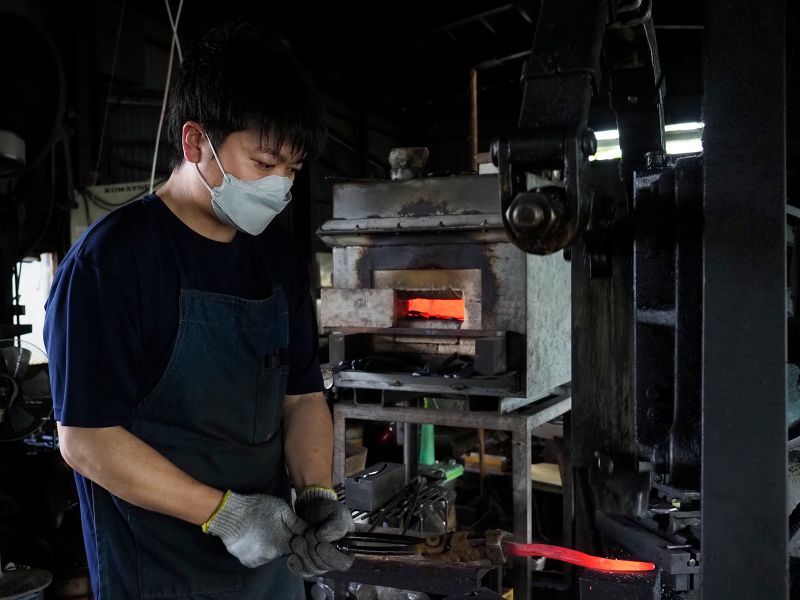
Tobisho has been forging blades in Yamagata since 1804, ten generations of blacksmiths, four of them dedicated to pruning shears. It was Syojiro Tobitsuka, the seventh-generation bladesmith in his family line, who founded Tobisho as a pruning shear forge in 1930, making him the first of four generations dedicated to shears.
Syojiro's shears served both the silkworm farmers already working the region and the orchardists who followed as Yamagata became one of Japan's great fruit-growing prefectures. The tools had to work. His name is still stamped on every Karikomi Shear Tobisho makes.
Generation by generation, the shears got better. What Tobisho is known for today, their heat treatment, their distinctive surface finish, is accumulated experience, made visible.
The late master Yasuhito Tobitsuka, third generation, developed the SR, the Hiryu, and the Asuka, and redesigned the A-type's handle. Daiki Tobitsuka, the fourth-generation master working at the forge today, has added the Hisui, the Hirei, and a Damascus steel A-type. His philosophy: "Cutting well is the baseline. Beyond that: simple and sturdy.", 質実剛健
Forging the Handle
Sharpening the Blade
Notes on use
IMPORTANT: This shear is made of High-Carbon Alloy Steel (Not Stainless Steel). It is exceptionally sharp but prone to rust if not maintained.
Do not twist or lever the blade during a cut.
Handle with care, blade-first drops risk chipping.
For one-handed use only. Right hand.
Designed for branches up to the thickness of a little finger. Use a saw beyond that.
Oil and clean regularly to prevent rust and blade separation.
Do not use on wire, rope, or any non-plant material.
Keep out of reach of children.
💬 Story of the SR Series - By Shop Manager (Part 3 of 3)
Topic: Learning the true depth of sizes from our customers.

Hiroshi Urata
Item Description
| Origin | Yamagata, Japan [TOBISHO] |
|---|---|
| Type | Gardening Tools > Scissors & Shears > Bypass Pruning Shears |
| Handedness | Right-Handed |
| Overall Length | 185 mm = 7.28 inch |
| Edge Length | 55 mm = 2.17 inch (From the center of a bolt to the top of a blade) |
| Construction | Integrally Forged |
| Edge Material | YCS-3 (Yasuki Steel) |
| Handle Material | YCS-3 (Yasuki Steel) |
| Item Weight | approx.220g |
| Shipping Weight | approx.290g (incl. box & packaging) |
Other Images
-
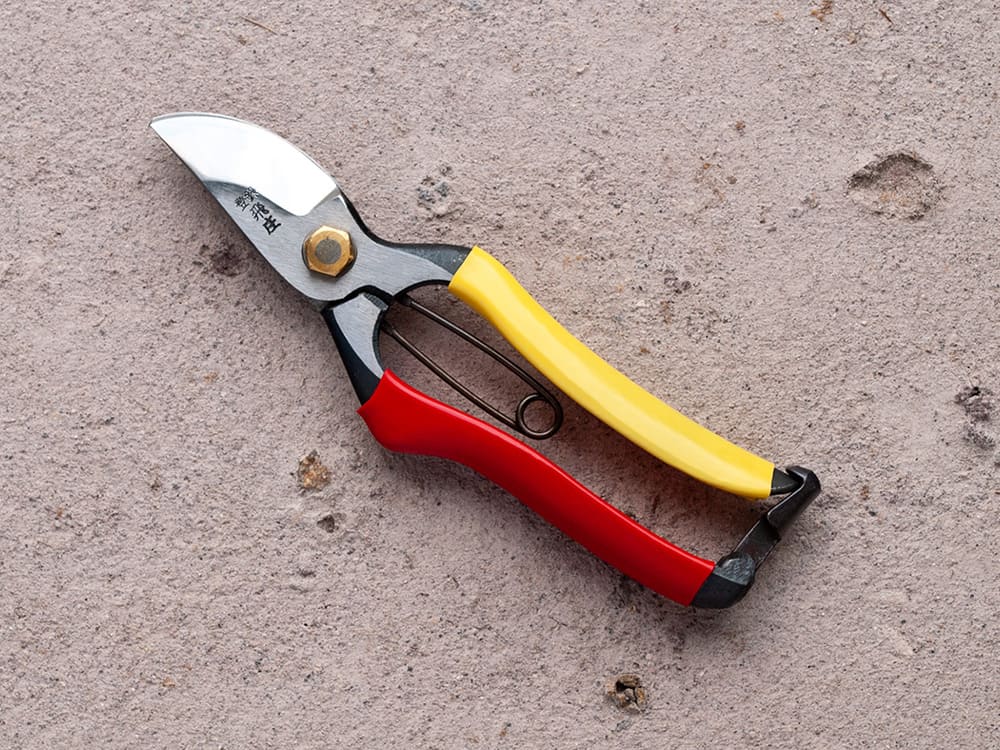
![Photo1: [Tobisho] SR-2 Pruning Shears 185mm (7.3")](https://www.tetsufuku.com/data/tetsufuku/_/70726f647563742f32303234303132345f6162643139322e6a7067003430300000740066.jpg) SR-2 with the latch open. The forged steel handle follows the natural curve of the right hand — the geometry that makes a long day's work easier.
SR-2 with the latch open. The forged steel handle follows the natural curve of the right hand — the geometry that makes a long day's work easier. -
![Photo2: [Tobisho] SR-2 Pruning Shears 185mm (7.3")](https://www.tetsufuku.com/data/tetsufuku/_/70726f647563742f32303234303132345f6666366230342e6a7067003430300000740066.jpg) Detail of the pivot bolt, blade spine, hamaguri-ba convex grind, and Tobisho stamp on the SR-2. Every element shaped by hand at the forge.
Detail of the pivot bolt, blade spine, hamaguri-ba convex grind, and Tobisho stamp on the SR-2. Every element shaped by hand at the forge. -
![Photo3: [Tobisho] SR-2 Pruning Shears 185mm (7.3")](https://www.tetsufuku.com/data/tetsufuku/_/70726f647563742f32303236303731305f3963663431322e6a7067003430300000740066.jpg) The inner face of the SR-2 blade. The ura-suki hollow grind runs the length of the cutting edge, allowing the two blades to meet with precision at every point of contact.
The inner face of the SR-2 blade. The ura-suki hollow grind runs the length of the cutting edge, allowing the two blades to meet with precision at every point of contact.
![Photo1: [Tobisho] SR-2 Pruning Shears 185mm (7.3")](https://www.tetsufuku.com/data/tetsufuku/product/20240124_abd192.jpg)
![Photo2: [Tobisho] SR-2 Pruning Shears 185mm (7.3")](https://www.tetsufuku.com/data/tetsufuku/product/20240124_ff6b04.jpg)
![Photo3: [Tobisho] SR-2 Pruning Shears 185mm (7.3")](https://www.tetsufuku.com/data/tetsufuku/product/20260710_9cf412.jpg)